+48 518 537 385
 office@shade4you.eu


Outdoor Advertising: What Is It and What Are the Main Types?
Quick Answer
Outdoor advertising, also known as out-of-home advertising (OOH), is any form of advertising designed to reach people in public or outdoor spaces. Common examples include billboards, posters, signs, digital screens, vehicle graphics, flags, branded umbrellas and advertising sun shade sails.
The effectiveness of outdoor advertising depends primarily on location, visibility, message clarity, format and repeated exposure. Some formats, such as advertising shade sails, can combine a promotional function with a practical purpose by providing shade or protection from rain.
What Is Outdoor Advertising?
Outdoor advertising is a form of visual communication displayed outside the home and designed to reach people while they are travelling, shopping, working, socialising or spending time outdoors.
Unlike online advertising, it does not require the audience to use a particular website, application or device. The advertising medium becomes part of the physical environment.
Outdoor advertising can be found around:
- high streets and shopping areas,
- roads and junctions,
- business premises,
- restaurants and cafés,
- hotels and leisure facilities,
- petrol stations,
- exhibitions and events,
- terraces and outdoor hospitality areas.
For businesses, the purpose can range from communicating a specific offer to increasing brand visibility or simply making a commercial location easier to recognise.
What Are the Main Types of Outdoor Advertising?
Outdoor advertising covers considerably more than traditional roadside billboards. The correct format depends on where the advertisement will be displayed, how long it will remain in place and what function it needs to perform.
Billboards and large-format advertising
Billboards are designed primarily for visibility at a distance. They work best where large numbers of people pass a fixed location.
Because viewers may have only a few seconds to notice the message, successful billboard designs normally rely on simple graphics, strong contrast and limited text.
Posters and signs
Posters, boards and signs are useful where viewers are able to see the advertisement from a shorter distance.
They can be used outside shops, restaurants, offices and service businesses to communicate branding, directions, opening information or current offers.
Digital outdoor advertising
Digital screens make it possible to change messages without physically replacing the advertising medium.
They are commonly used in busy commercial locations, transport environments and shopping areas.
Flags and portable advertising
Advertising flags and similar freestanding formats are useful when mobility is important.
They can be placed near entrances, at events or alongside temporary commercial areas and moved when required.
Vehicle advertising
Cars, vans, buses and other vehicles can also become mobile advertising surfaces.
Unlike a fixed billboard, vehicle graphics allow the advertising message to move between different locations.
Advertising sun shade sails
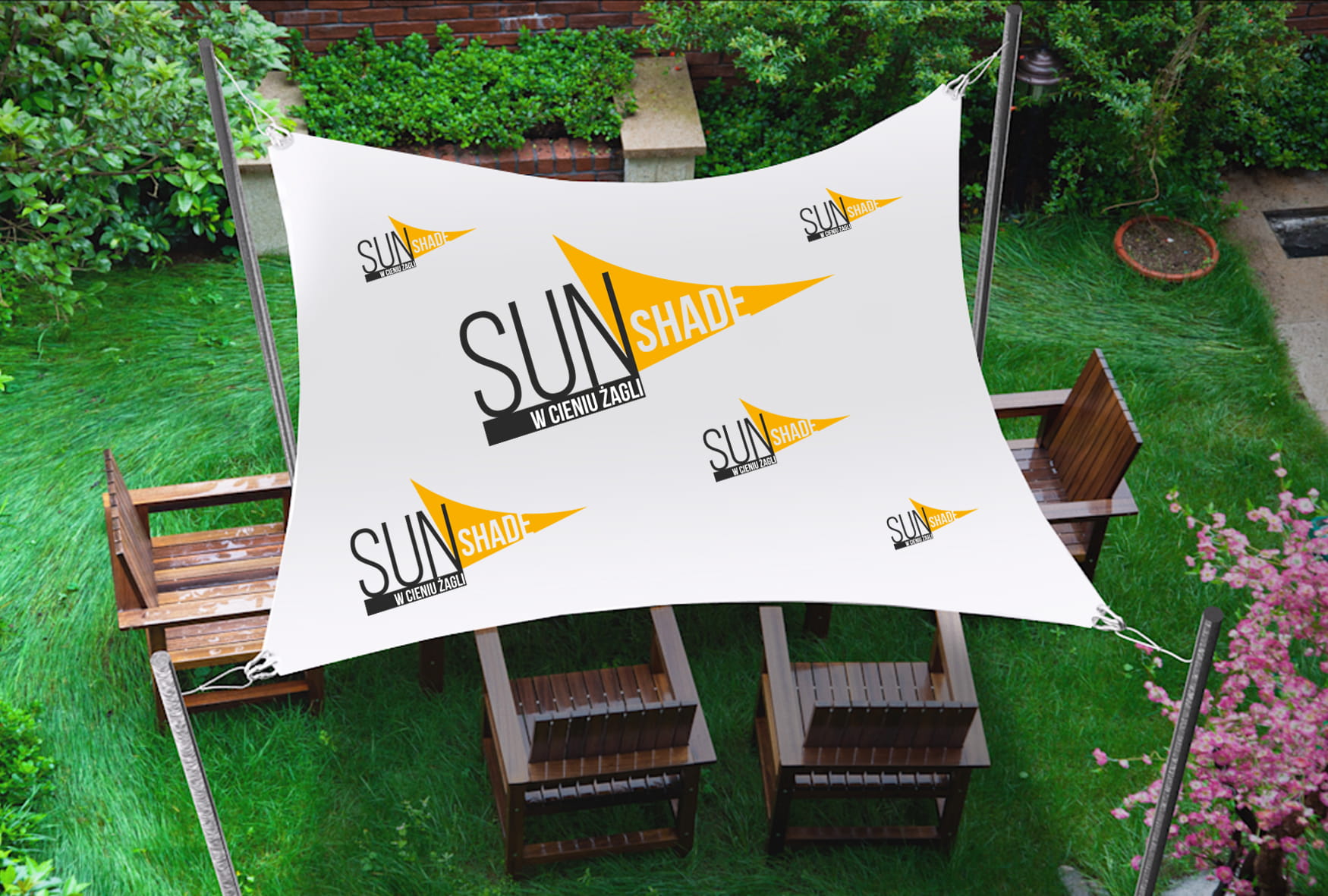
An advertising sun shade sail combines a large printable surface with a practical outdoor function.
Instead of installing an advertising element purely for visual communication, the same surface can provide shade and, depending on the material, protection from rain.
This makes the format particularly relevant to terraces, hospitality areas, events, leisure facilities and other outdoor commercial spaces.
What Is an Advertising Sun Shade Sail?
An advertising sun shade sail is a tensioned fabric structure carrying printed graphics, branding or another visual message.
It can therefore perform two functions simultaneously:
- create a shaded or sheltered outdoor area,
- display a brand, logo or graphic.
This is fundamentally different from a conventional billboard because the advertising medium becomes part of the usable outdoor space.
A made-to-measure advertising sail can also be adapted to the available mounting points rather than forcing the outdoor area to accommodate a predefined advertising format.
A waterproof advertising sail made from Decor fabric can combine printed graphics with practical protection from sun and rain. Depending on the installation, additional mounting points and drainage solutions can also be considered.
Where Do Advertising Shade Sails Work Best?
Restaurants, pubs and cafés
A printed sail can shade an outdoor seating area while displaying the establishment's branding.
The advertising surface is positioned directly within the area being used by customers rather than being separated from it.
Hotels and leisure facilities
Advertising sails can help identify particular zones while simultaneously creating sheltered outdoor areas.
Events and exhibitions
A distinctive printed overhead surface can make a stand, meeting point or hospitality zone easier to recognise.
Shops and commercial premises
Where sufficient outdoor space and suitable mounting points are available, an advertising sail can combine exterior branding with functional shading.
Seasonal outdoor areas
A removable fabric structure can be useful where the outdoor area changes between seasons and a permanent advertising structure is unnecessary.
What Are the Benefits of Outdoor Advertising?
High physical visibility
Outdoor advertising occupies real space. Correct positioning can make it visible to pedestrians, drivers, customers or visitors without requiring them to actively search for the brand.
Repeated exposure
People frequently travel along the same roads, walk through the same neighbourhoods and visit the same commercial areas.
A permanent or semi-permanent outdoor advertisement can therefore be seen repeatedly, supporting brand recognition over time.
Local communication
Outdoor advertising is particularly useful when a company wants to communicate with people already close to its premises or service area.
Different formats for different locations
A billboard, flag, vehicle graphic and advertising sail solve different problems.
This allows the advertising medium to be selected according to the physical environment rather than applying the same format everywhere.
Combining advertising with another function
This is particularly relevant to advertising sails and umbrellas.
The surface does not have to exist exclusively for advertising. It can simultaneously provide shade, define an outdoor zone and contribute to protection from weather.
Waterproof Advertising Sails – What Should You Know?
A waterproof advertising sail requires more planning than a standard printed banner or flag.
Because the fabric does not allow rainwater to pass freely through the surface, water management becomes part of the installation design.
A waterproof Decor sail should therefore be installed with an appropriate slope so that rainwater can leave the surface instead of collecting in one area.
Why is the installation angle important?
A waterproof sail effectively creates a roof-like surface.
If rainwater cannot escape, it can accumulate in the lowest part of the sail. The resulting water load can place unnecessary stress on:
- the fabric,
- seams,
- mounting hardware,
- supporting structures.
For this reason, drainage should be considered before deciding where the mounting points will be positioned.
What Is an Optional Drainage Eyelet?
For selected waterproof advertising sails made from Decor fabric, an optional drainage eyelet can be added.
It is a reinforced drainage point placed in a selected area of the sail to support controlled water removal.
When can a drainage eyelet be useful?
It can be considered when:
- the geometry makes natural drainage more difficult,
- a specific drainage point is required,
- the installation has limited possibilities for creating the ideal slope,
- water needs to be directed away from a particular part of the terrace.
What is the function of a drainage eyelet?
A correctly positioned drainage eyelet can:
- reduce the risk of water accumulation,
- support controlled drainage,
- make complex installations easier to plan,
- help direct rainwater towards a selected drainage area.
Important: a drainage eyelet should be treated as an additional water-management feature. It does not replace the need for correct installation geometry and an appropriate slope.
How Should an Effective Outdoor Advertisement Be Designed?
Keep the message simple
People often have only a short time to understand outdoor advertising. Long paragraphs and complicated messages are therefore rarely appropriate.
Design for viewing distance
A graphic intended to be viewed from 20 metres away requires a different scale from branding positioned directly above a restaurant terrace.
Use clear contrast
Logos, lettering and essential visual elements should remain recognisable against the background.
Consider the shape of the advertising medium
With an advertising sail, the graphic must work with the finished geometry of the fabric.
The design should therefore account for edges, mounting points, tension and the visible orientation of the installed sail.
Think about the installation environment
Trees, beams, walls and surrounding buildings can affect visibility.
The advertising design should be evaluated in the context of the actual installation rather than only on a computer screen.
Practical Checklist Before Ordering an Advertising Sail
Before ordering, establish:
- where the sail will be installed,
- who should see the advertising message,
- the required dimensions,
- the position of all mounting points,
- the orientation of the printed side,
- whether rain protection is required,
- where rainwater should drain,
- whether an optional drainage eyelet is required,
- whether additional mounting points are needed,
- whether the supporting structure is sufficiently rigid.
For made-to-measure sails, accurate measurements are particularly important because the geometry of the finished product determines how it can be tensioned.
What Are the Most Common Mistakes with Advertising Sails?
Designing the graphic before establishing orientation
The visible side and installation direction should be confirmed before the artwork is finalised.
Treating the sail like a flat advertising banner
A tensioned sail has a three-dimensional installed geometry. The final appearance of the graphic needs to account for this.
Ignoring rainwater
For a waterproof advertising sail, drainage is a structural consideration rather than an optional aesthetic detail.
Using weak mounting structures
A large tensioned surface is exposed to wind. Fixing points and supporting structures therefore need to be appropriate for the loads involved.
Adding too much information
An advertising sail should normally communicate branding or a concise message. Trying to reproduce a leaflet on an overhead surface makes the design harder to read.
Manufacturer's Perspective: What Matters in an Advertising Sail?
From a manufacturer's perspective, an effective advertising sail is not simply a piece of printed fabric.
Four elements need to work together: graphic design, fabric, geometry and installation.
The artwork needs to remain legible after the fabric has been tensioned. The material needs to match the expected weather protection. The geometry needs to suit the available space, while the mounting system must maintain appropriate tension.
For waterproof models, water drainage becomes an additional design consideration. This is why installation slope, additional mounting points and optional drainage eyelets should be considered at the planning stage rather than after installation.
For non-standard spaces, made-to-measure production and individual technical consultation can help ensure that the advertising sail matches the actual installation conditions.
Outdoor Advertising – Key Facts
Outdoor advertising is advertising displayed in public and outdoor environments to reach people away from their homes. Common formats include billboards, posters, signs, digital displays, flags, vehicle graphics and advertising shade sails.
Advertising sun shade sails differ from many traditional formats because they can combine brand communication with a practical shading or shelter function.
Waterproof advertising sails require appropriate slope and planned water drainage. For selected Decor sails, an optional drainage eyelet can support controlled water removal.
The best outdoor advertising format depends on location, viewing distance, required exposure and the practical function of the installation.
FAQ – Outdoor Advertising and Advertising Sun Shade Sails
What is outdoor advertising?
Outdoor advertising is promotional communication displayed in public or outdoor spaces, including billboards, posters, signs, digital displays, flags, vehicle graphics and other physical advertising media.
What is an advertising sun shade sail?
It is a tensioned fabric sail carrying printed graphics or branding that can simultaneously provide shade or weather protection.
Can an advertising sail protect against rain?
Yes. A waterproof advertising sail made from a suitable material such as Decor can provide rain protection, provided it is correctly installed with adequate slope and drainage.
Does a waterproof advertising sail need to be installed at an angle?
Yes. A waterproof surface must allow rainwater to drain rather than accumulate on the fabric.
What is an optional drainage eyelet?
It is a reinforced drainage opening added to the sail to support controlled removal of rainwater from a selected point.
Can advertising sails be made to measure?
Yes. Made-to-measure advertising sails can be adapted to the dimensions, geometry and mounting points of the intended installation.