+48 518 537 385
 office@shade4you.eu


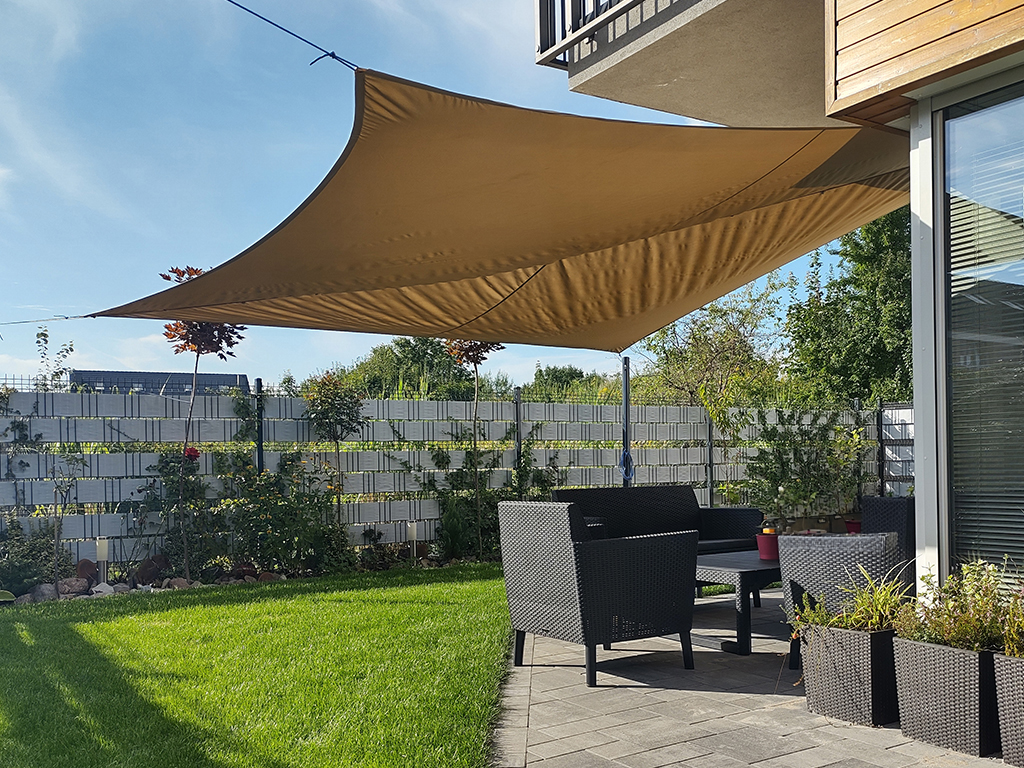
Corner-Mounted Sun Shade Sails – Installation, Structure and Common Technical Questions
Quick Answer
Corner-mounted sun shade sails are tensioned membrane structures that transfer loads through reinforced corners while maintaining controlled curvature across the surface. Correct installation requires properly positioned mounting points, rigid support structures and suitable tensioning hardware. Understanding sail geometry and tension distribution helps prevent common problems such as sagging, uneven tension or deformation during wind.
Introduction
Corner-mounted sun shade sails are one of the most practical solutions for creating shaded outdoor areas over patios, terraces and garden seating spaces. When installed correctly, they provide reliable sun protection, improve outdoor comfort and add a clean architectural element to the space.
Many installation problems occur because a shade sail is often mistaken for a flat tarp or canopy. In reality, a shade sail works as a tensioned membrane structure where the fabric distributes forces across the surface and transfers them to the mounting points.
Understanding the basic principles of shade sail construction helps avoid common installation mistakes and ensures a long-lasting, stable installation.
This guide explains the key technical aspects of corner-mounted shade sails, including fabric orientation, additional mounting points, structural reinforcement and the most common causes of sagging.
What Is a Corner-Mounted Shade Sail and How Does It Work?
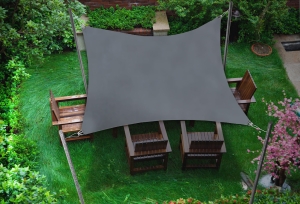
A corner-mounted shade sail is a fabric structure tensioned between three or four mounting points. Instead of relying on rigid beams, the stability of the structure comes from properly distributed tension forces.
The main structural principles include:
• tension transferred to reinforced corners
• curved edges that allow even load distribution
• multidirectional tension across the fabric
• rigid mounting points that absorb structural load
When these principles are respected, the sail maintains a smooth surface and safely transfers wind loads to the supporting structures.
Which Side of the Shade Sail Should Face Downwards?
If the sail contains printed graphics or markings, the print is applied to the outer visible side of the fabric.
In most installations this means the printed side faces downwards toward the seating area.
Correct orientation matters for two reasons.
Visual appearance
The printed side is intended to be visible from below.
Material structure
Many technical fabrics have a defined front and back side, which may affect durability and appearance.
When ordering a custom sail, it is recommended to include a simple top-view sketch of the installation area showing the orientation of the sail relative to the mounting points.
Can Additional Mounting Points Be Added to a Shade Sail?
Yes, additional mounting points can be sewn onto a shade sail. However, this modification changes the structural geometry of the sail.
Because of this, sails with additional anchor points are treated as custom-made products.
Each mounting point influences how tension forces are distributed across the membrane. Adding extra points without proper design can cause:
• uneven tension distribution
• distortion of the sail surface
• excessive load on specific corners
For this reason, additional mounting points must always be considered during the design and production stage.
Professional manufacturers adjust the geometry of the sail to ensure that forces are correctly transferred through reinforced corners and edges.
Can You Order a Custom-Made Shade Sail?
Yes. Many outdoor installations require sails that cannot be produced using standard sizes.
Custom-made sails are typically required for:
• triangular sails
• irregular quadrilateral shapes
• very small or very large installations
• sails with printed graphics
• non-standard colours
• sails with additional mounting points
Standard square and rectangular waterproof shade sails can usually be ordered directly through an online configurator.
For irregular shapes it is best to provide:
• a top-view sketch of the installation area
• measured distances between all mounting points
For irregular quadrilaterals it is also helpful to provide the length of one diagonal, which allows the geometry to be calculated precisely.
As a general guideline, shade sails perform best when the surface area does not exceed approximately 20 m² and the maximum side length is around 7 metres.
Larger structures are technically possible but typically require individual technical consultation.
Why Do Some Shade Sails Include a Steel Cable in the Edge?
Some corner-mounted sails are produced with a stainless steel cable sewn into the perimeter tunnel.
This reinforcement improves structural stability and helps distribute tension forces more evenly.
Advantages of cable-reinforced edges include:
Improved edge straightness
The cable helps maintain a clean and straight edge line.
More even tension distribution
Forces are transferred along the entire edge instead of concentrating only in the corners.
Greater wind resistance
The reinforced edge reduces deformation during strong wind loads.
Increased durability
The cable provides additional structural reinforcement to the sail perimeter.
Installation considerations should also be taken into account. Cable-reinforced sails generate higher tension forces, so mounting structures must be very rigid and installation hardware must be correctly rated.
In waterproof materials such as PVC 650 g/m², the reinforced edge may sit slightly higher, which can slightly influence water drainage angles.
Why Do Shade Sails Have Curved Edges?
One of the most misunderstood design elements of shade sails is the concave curvature of their edges.
Shade sails are intentionally cut with curved edges because this shape allows the fabric to tension evenly across the entire surface.
For most corner-mounted sails made from waterproof materials, the standard concave arch depth is approximately 20 cm per side.
In larger triangular sails the curvature may reach up to 45 cm depending on the overall dimensions.
Without this curvature the fabric would almost always sag in the centre.
Why Does a Shade Sail Sag in the Middle?
Sagging is one of the most common installation problems.
In most cases the issue is not the sail itself but the installation geometry or insufficiently rigid support structures.
Common causes include excessive span distance between mounting points. If the distance exceeds approximately 6–8 metres, standard tensioning hardware may not provide enough tension.
Flexible mounting structures are another common issue. Posts or wall brackets that bend under load reduce the tension across the sail surface.
Another frequent mistake is attempting to create a perfectly flat surface. Shade sails are designed to maintain controlled curvature in the centre.
Trying to eliminate this curvature often leads to over-tensioning and structural stress.
In some cases a visible wave may appear along one diagonal of the sail, particularly in mesh materials. This usually indicates uneven tension distribution and can often be corrected by slightly reducing tension along that diagonal.
Practical Installation Checklist
Before installing a corner-mounted shade sail, it is worth checking several key factors.
Installation checklist
• mounting points positioned correctly
• posts or wall brackets structurally rigid
• suitable tensioning hardware installed
• curved sail edges considered in mounting distances
• drainage slope planned for waterproof fabrics
• height differences between mounting points provided
Common installation mistakes include placing mounting points too close together, using flexible posts, over-tensioning the sail or ignoring the curved edge geometry.
Correct installation ensures both aesthetic appearance and structural durability.
Expert Insight from the Manufacturer
From a manufacturing perspective, the performance of a shade sail depends mainly on geometry and structural support.
Even the highest quality fabric cannot compensate for incorrectly positioned mounting points or weak support structures.
When designing custom shade sails, manufacturers analyse several important factors including load transfer to the corners, required curvature of the edges, expected wind loads and rigidity of mounting structures.
For complex installations it is often beneficial to consult the manufacturer before ordering a sail.
Professional manufacturers typically use premium outdoor materials and European manufacturing standards to ensure durability, consistent quality and reliable long-term performance.
Summary
Corner-mounted sun shade sails are engineered tension structures rather than simple fabric covers. Their stability depends on correct geometry, appropriate mounting points and proper tension distribution.
Curved edges, reinforced corners and high-quality outdoor materials all contribute to maintaining structural balance and durability.
Understanding these technical principles helps prevent common issues such as sagging, uneven tension or deformation during strong winds.
For irregular installations or non-standard dimensions, a custom-made shade sail designed specifically for your mounting points is usually the most reliable solution.
FAQ – Corner-Mounted Shade Sails
Can a shade sail be completely flat?
No. Shade sails must maintain controlled curvature in order to transfer tension forces correctly.
What is the recommended maximum size for a shade sail?
For most installations sails up to around 20 m² with sides up to approximately 7 metres perform best.
Do shade sails require strong mounting posts?
Yes. Shade sails generate significant tension forces, so mounting structures must be rigid and properly anchored.
Can a shade sail be manufactured in a custom shape?
Yes. Shade sails can be produced in triangular, irregular or polygon shapes when accurate mounting point measurements are provided.
Total reviews: 17 reviews