+48 518 537 385
 office@shade4you.eu


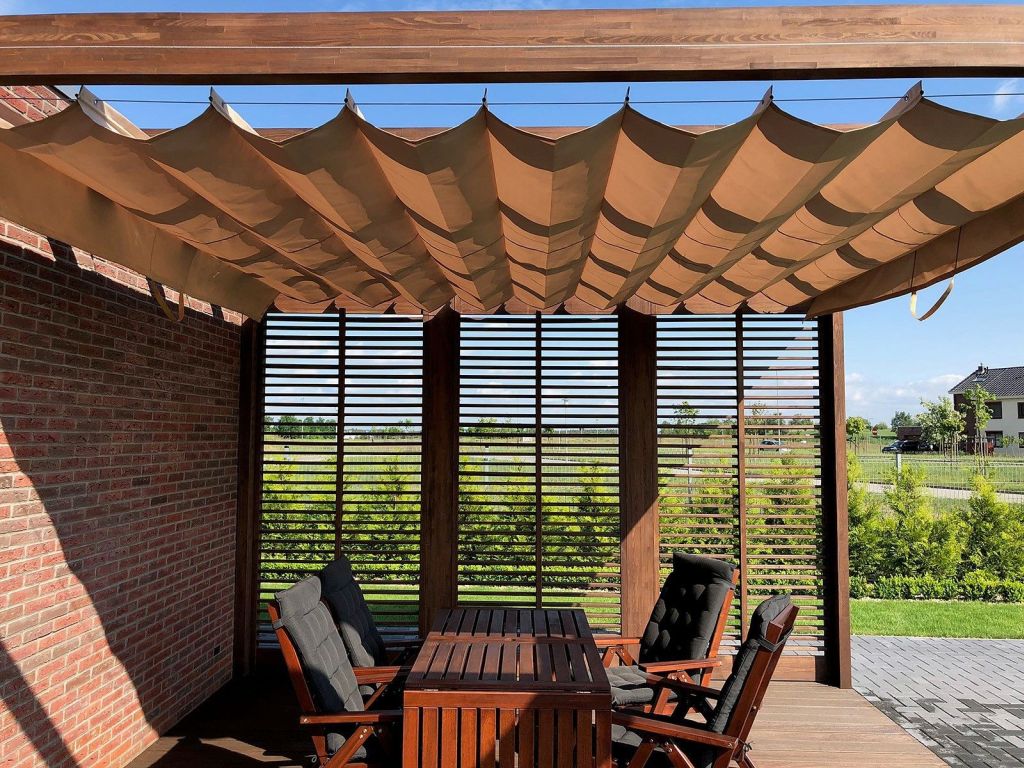
A retractable shade sail and a horizontal Roman blind both operate on stainless steel guide wires, but they differ significantly in construction, water behaviour and structural performance. Retractable sails offer a lighter sliding membrane solution, while Roman blinds provide greater control of water runoff and structural stability. Fabric selection — HDPE 285 g/m², Premium Decor or PVC 650 g/m² — should reflect wind exposure and rain requirements typical in the UK.
Introduction
In the UK climate, shading systems must cope with wind, variable rainfall and seasonal changes. Retractable shade sails and Roman blinds are increasingly used for pergolas, terraces and garden seating areas because they provide flexible coverage without permanent enclosure.
Although visually similar, these systems behave differently under load. This guide explains structural differences, wire configurations, sagging values and correct material selection for long-term outdoor durability.
What Is the Structural Difference Between a Retractable Shade Sail and a Roman Blind?
Retractable Shade Sails
Retractable shade sails are manufactured in:
- HDPE 285 g/m² – breathable, wind-tolerant fabric allowing airflow and heat reduction,
- Premium Decor – waterproof fabric for rain protection.
The edges are finished with punched eyelets every approximately 50 cm. Steel guide wires pass directly through these eyelets.
When extended, the sail forms a natural central curve. In waterproof fabrics, this may create a shallow basin effect where rainwater can temporarily collect. For this reason, retractable sails require more maintenance awareness compared to Roman blinds.
From a width of 2.3 metres, Premium Decor sails include a central load-bearing strap with carabiners to guide a third wire for additional stability.
Horizontal Roman Blinds
Roman blinds are available in:
- Premium Decor,
- PVC 650 g/m² – heavy-duty waterproof fabric with increased mechanical resistance.
Instead of eyelets, Roman blinds feature sewn tunnels at approx. 50 cm intervals. Aluminium stiffening tubes are inserted into these tunnels. Above each tunnel, a reinforced strap with eyelets guides the wire.
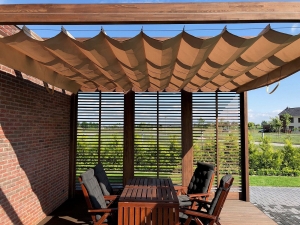
When extended, the blind forms structured valances. Each valance acts as a controlled drainage channel, making water runoff more predictable — an important advantage in UK rainfall conditions.
How Are They Operated and How Many Wires Are Required?
Both systems are manually operated using a sliding handle positioned at the leading edge.
Wire Configuration – Retractable Shade Sails
- Up to 2.3 m width – 2 wires,
- From 2.3 m width – 3 wires.
Wire Configuration – Roman Blinds
- Up to approx. 1.5 m – 2 wires,
- 1.55 m to 3.12 m – 3 wires,
- 3.15 m to 4.5 m – 4 wires.
Final wire configuration depends on width, fabric weight and structural span.
How Much Does the System Sag Below the Wire?
With standard finishing:
Retractable Shade Sails
- Approx. 18 cm sag when extended,
- Approx. 30 cm sag when retracted,
- Protrusion above wire: 1.5–3 cm.
Roman Blinds
- Approx. 12 cm sag when extended,
- Approx. 28 cm sag when retracted,
- Protrusion above wire: approx. 0.8 cm.
These values must be considered when planning installation height, especially in pergola systems.
Is the Long Final Valance Necessary in Roman Blinds?
Yes, in most cases. The final valance provides structural balance and assists in controlled water drainage.
It may be shortened in specific cases — for example when installed directly adjacent to a wall or window — but such modifications should be assessed individually.
How to Operate Systems Installed Above 2.5 Metres?
For installations at greater height:
- Attach a cord extension to the handle,
- Extend the final valance,
- Install a pulley-and-cord system (must be specified during ordering).
Any pulley system should be considered at production stage to ensure correct finishing.
Material Selection for UK Conditions
Material choice significantly influences performance:
- HDPE 285 g/m² – breathable, ideal for airflow and wind exposure.
- Premium Decor – waterproof, requires installation slope for drainage.
- PVC 650 g/m² – heavy-duty waterproof fabric used in horizontal Roman blinds where increased durability is required.
Both retractable shade sails and Roman blinds are manufactured in Europe using Premium Outdoor Materials and engineered for long-term structural performance.
For waterproof models, see: Waterproof Shade Sails .
Conclusion
Retractable shade sails provide a lighter, flexible shading solution. Roman blinds offer greater structural control and improved water management. Correct wire configuration, structural rigidity and appropriate fabric selection are critical for reliable performance in UK weather conditions.
FAQ
Is HDPE waterproof?
No. HDPE 285 g/m² is breathable and allows airflow but does not provide rain protection.
Which system is better for heavy rain?
Roman blinds in Premium Decor or PVC 650 g/m² offer more controlled drainage compared to retractable sails.
Can both systems be installed in pergolas?
Yes, provided the structure is rigid and capable of handling tension loads.
Does a retractable sail always sag in the middle?
Yes. Controlled curvature is structurally necessary and not a defect.
Is PVC 650 g/m² suitable for retractable sails?
PVC 650 g/m² is primarily used in horizontal Roman blinds due to its weight and structural behaviour.
Total reviews: 18 reviews